The rapid integration of Southwest Florida AI construction technology is ushering in a transformative era for commercial building, moving artificial intelligence from experimental pilots straight into active, heavy-duty jobsites across the Gulf coast corridor. Far from being a novelty confined to tech startups, regional industry heavyweights—including Suffolk Construction, Stevens Construction, and DeAngelis Diamond—are investing millions of dollars to integrate machine learning, automated scheduling, and proprietary software directly into multi-million-dollar builds.
From massive regional transportation megaprojects to coastal residential developments and acute-care hospitals, builders are proving that software engineers and algorithms are just as critical to modern jobsite productivity as cranes and concrete trucks. By mining gigabytes of historical data, streamlining bureaucratic paperwork, and predicting project pinch points, AI is fundamentally altering how contractors manage costs, labor shortages, and aggressive delivery timelines.
Jobsite of the Future at Southwest Florida International Airport
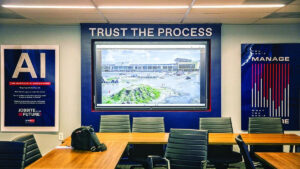
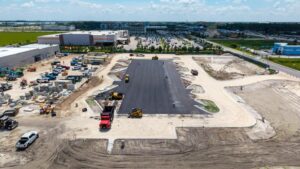
On the southwest perimeter of Southwest Florida International Airport (RSW) in Fort Myers, Suffolk Construction is testing the vanguard of Southwest Florida AI construction technology on its estimated $1.2 billion Phase 2 Terminal Expansion. Out of Suffolk’s 275 active jobsites nationwide, the RSW expansion represents one of only eight designated as a Jobsite of the Future (JOF), equipped with an on-site software engineer and a dedicated AI war room inside a field trailer.
Leading this technological charge is Cary Greenwood, a former data architect for NV5 who previously engineered government systems for the U.S. Army Corps of Engineers and NASA, as well as defense software for Raytheon. Greenwood was brought in to optimize the complex lifecycle of Requests for Information (RFIs)—the essential technical documentation exchanged between general contractors, architects, and structural engineers whenever questions arise over plans.
According to Dwight Moe, Suffolk’s assistant project manager, the productivity transformation was instantaneous:
-
Slashing RFI Processing Times: Before Greenwood joined the project in February 2026, preparing and cross-referencing a technical RFI required six to eight hours of manual research. Utilizing custom AI mining tools that scan gigabytes of submittals and siloed plans, that timeline has shrunk to 10 to 15 minutes.
-
Data Integration: The software aggregates unstructured blueprint data, engineering specifications, and historical queries into customized algorithmic workflows that pinpoint answers in seconds.
-
Predictive Operations: Lessons learned and software solutions tested at the RSW terminal site are systematically packaged to establish operational best practices for future airport, healthcare, and high-rise developments nationwide.
From Paper Blueprints to Enterprise AI at Stevens Construction
In south Fort Myers, Stevens Construction has embedded machine learning across all administrative and field operations, including its recently completed rebuilding of Beachview Villas on Sanibel Island. Founded in 2003 by Mark Stevens, the company has witnessed a dramatic operational shift from traditional paper blueprints to cloud-connected field tablets.
While the firm began exploring automation several years ago, adoption surged exponentially over the past two years, pushed forward by a younger generation of project managers and estimators. Today, virtually every department at Stevens Construction leverages artificial intelligence to enhance daily output:
-
Project Estimating & Plan Coordination: Estimators deploy automated tools to accelerate quantity takeoffs, compare plan revisions, and detect design discrepancies before ground is broken.
-
Administrative Workflows: Field superintendents utilize natural language processing to formulate RFIs, structure daily progress logs, and standardize subcontractor communications.
-
Predictive Financial Modeling: The accounting division applies machine learning algorithms to generate real-time financial forecasts, monitor cash-flow trends, track key performance indicators (KPIs), and flag potential cost overruns well in advance.
DeAngelis Diamond and Future Bylt: Commercializing Construction Tech
In Naples, general contracting powerhouse DeAngelis Diamond—approaching roughly $700 million in annual revenue across 70 active jobsites—has taken construction tech one step further. Rather than merely adopting third-party applications, the firm founded an independent technology offshoot in April 2025 named Future Bylt.
Dedicated entirely to developing AI-powered software, Future Bylt has expanded rapidly from six to 18 full-time software developers and data scientists. Operating under the direction of Chief Innovation Officer Brett Diamond, the incubator operates as an agile test lab, using Anthropic’s Claude Code and modern development frameworks to build proprietary tools that will eventually be licensed to outside contractors:
-
Bolt: A unified, proprietary project management engine that continuously aggregates financial data, supply schedules, and RFI statuses into an intelligent dashboard for real-time risk assessment.
-
Squads: An automated workforce-allocation platform that evaluates active and upcoming commercial projects, using algorithmic scoring to recommend the ideal staffing and superintendents for specific build scopes.
-
Scout: A specialized AI talent-acquisition tool that scours technical databases and trade networks to recruit skilled construction managers and estimators amid persistent nationwide labor shortages.
-
Robotics Exploration: Looking ahead, DeAngelis Diamond and Future Bylt are actively researching advanced robotics to automate repetitive jobsite physical tasks, mirroring modern automotive assembly lines.
Modernizing Infrastructure Delivery Across Southwest Florida
The accelerating deployment of artificial intelligence comes at a pivotal moment for Southwest Florida, where intense population growth demands continuous expansion of roadways, healthcare hubs, and airport infrastructure. Contractors who successfully pair human craftsmanship with algorithmic efficiency are better equipped to navigate supply volatility, control labor expenses, and keep complex projects on schedule.
To explore how other major civil infrastructure and site development firms are scaling their operations to meet regional demand, read our report on the Continental Infrastructure Group Florida expansion.