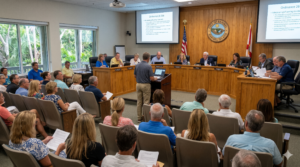
The commercial landscape of Sanibel Island is entering a new era of highly regulated recreation. On Tuesday, November 3, 2026, the Sanibel City Council officially convened a formal public hearing at MacKenzie Hall to discuss the highly anticipated Sanibel miniature golf Ordinance 26-016. This critical piece of local legislation officially establishes strict land-use regulations that would permit miniature golf courses to operate strictly as a conditional use within the island’s General Commercial District.
For decades, Sanibel has famously restricted high-intensity tourist attractions to protect its natural ecosystems and quiet, residential character—a mandate famously codified in the historic Sanibel Plan. However, as local business owners look to responsibly rebuild and reinvest following the catastrophic impacts of recent hurricane seasons, city planners are actively exploring how to introduce family-friendly recreational amenities without compromising the sanctuary island’s core environmental identity.
The Origins of the Sanibel Miniature Golf Ordinance 26-016
The community conversation surrounding the Sanibel miniature golf Ordinance 26-016 was originally catalyzed by veteran island merchants Brian and Elke Podlasek, owners of the beloved Island Cow restaurant. After their iconic Periwinkle Way establishment was devastated by a massive fire and subsequently impacted by major hurricanes, the ownership team sought to rebuild the site with a completely revitalized vision. They proposed integrating a low-key, family-friendly outdoor recreation space alongside their newly rebuilt restaurant.
While the Island Cow’s redevelopment proposal helped initiate the drafting of this new ordinance, city officials have consistently emphasized that this legislation does not serve as a blanket approval for any single business. Instead, it creates a comprehensive, island-wide regulatory framework for how commercial recreation must be handled moving forward.
If the ordinance is fully adopted by the City Council, miniature golf courses will not become automatically permitted on any commercial property along Periwinkle Way or elsewhere. Rather, any prospective developer must apply for a highly scrutinized conditional use approval through the Sanibel Planning Commission. During this process, applicants must definitively prove that their specific project adheres to the island’s stringent environmental guidelines and aesthetic standards before breaking ground.
Setting Strict Design Standards Under the Sanibel Miniature Golf Ordinance 26-016
To ensure that the island does not evolve into a bustling strip of tourist traps, the Sanibel miniature golf Ordinance 26-016 imposes some of the strictest commercial recreational zoning rules in all of Southwest Florida. The City Council has made it abundantly clear that standard, roadside amusement attractions have absolutely no place on Sanibel.
Under the proposed regulations, any approved course must operate as a low-profile, botanical putting green. The courses are explicitly required to utilize substantial native vegetation in their site buffering and landscaping, seamlessly weaving the recreational space into the surrounding natural environment. To physically preserve the island’s unique, low-impact aesthetic character, the ordinance strictly bans all traditional amusement-style themes. Future developers are expressly prohibited from installing features commonly found at off-island facilities, such as windmills, pirate ships, large statues, fiberglass dinosaurs, or flashing neon lights.
Furthermore, the ordinance mandates the use of permeable, ecologically friendly materials for the custom putting surfaces and surrounding walkways. This requirement ensures that any new recreational construction actively assists with stormwater runoff management and groundwater recharge, keeping in step with the island’s robust conservation goals.
Protecting the Sanctuary Island Experience
Beyond visual aesthetics and physical design, the Sanibel miniature golf Ordinance 26-016 directly addresses potential quality-of-life concerns for neighboring residential properties. A major, defining component of the legislation is the implementation of a 3.5-mile geographic separation requirement between any approved courses. This strict distancing rule guarantees that the island will not see a concentrated cluster of commercial golf facilities, effectively preventing the “strip mall” feel common in other coastal Florida tourism hubs.
Additionally, any proposed miniature golf facility must operate in full compliance with Sanibel’s legendary dark-sky lighting ordinances. These regulations are meticulously designed to minimize light pollution, protecting nocturnal wildlife and nesting sea turtles while maintaining the island’s quiet evening ambiance. Planners have also integrated low-decibel noise limits into the conditional use requirements, ensuring that evening recreational activities do not disturb nearby residents or disrupt the tranquility of the barrier island.
The public hearing at MacKenzie Hall highlighted the intense passion and deep involvement of the Sanibel community. While some residents view the ordinance as a practical, measured way to support local business recovery and provide activities for year-round families, others remain cautious about the precedent it sets for future commercial development along the Periwinkle corridor.
This ongoing debate over post-storm rebuilding and commercial zoning is playing out dynamically across the region. To see how neighboring barrier islands are handling large-scale commercial land use and balancing property rights with community history, review our recent coverage of the South Seas Resort Captiva rezoning approval and the Waterside Inn redevelopment Sanibel.
As Sanibel Island continues to navigate its economic recovery and commercial rebuilding phase, do you believe these strict botanical and lighting regulations are enough to protect the island’s sanctuary character while allowing new family amenities to open?