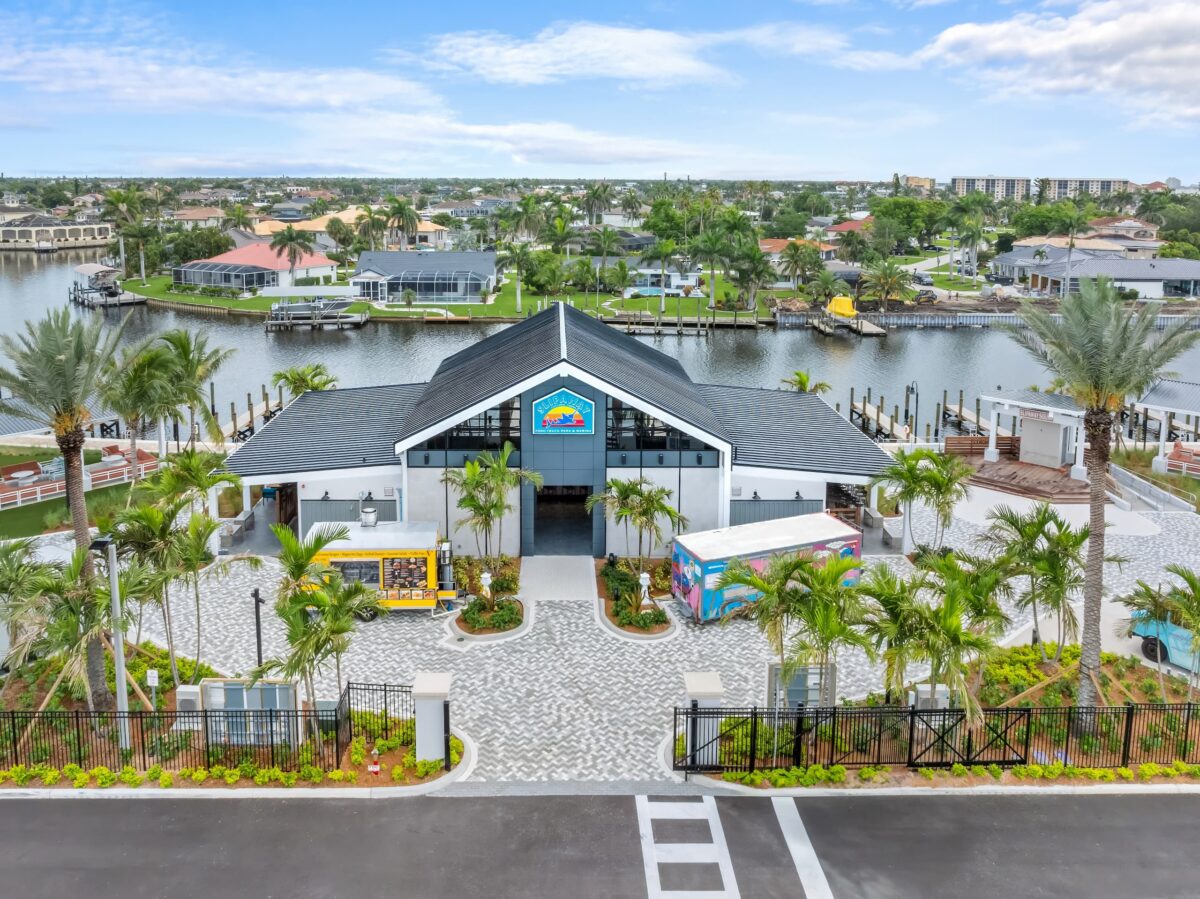
Since its grand opening on July 4, Slipaway Food Truck Park & Marina has quickly become a must-visit waterfront destination in Cape Coral, attracting thousands of visitors each week. The thriving venue has now secured nearly $1 million in city-backed funding to help offset its $19 million development costs.
In a series of votes held on July 30, the city’s Community Redevelopment Agency (CRA) approved two funding requests from Slipaway’s developers, Cape Parkway LLC and Water City Park LLC. This includes a $250,000 Business Infrastructure Grant and $726,561 in Tax Increment Financing (TIF).
The project is led by longtime Southwest Florida residents Jeff Miloff, Gary Aubuchon, Scott Fischer, Sandra Dean, John Kulhavi, Chuck McGuirk, and Rick McGuirk.
The CRA board, consisting of Cape City Council members, unanimously approved the smaller grant amount. However, CRA members Bill Steinke, Keith Long, and Rachel Kaduk recused themselves from voting due to conflicts of interest, citing personal business ties with Slipaway’s owners. Despite this, they do not stand to profit or lose financially from the project.
In a separate 3-2 vote, the CRA approved the larger TIF funds, though City Council members Jennifer Nelson-Lastra and Laurie Lehmann voted against the approval. They argued that the funding should have been requested before construction began, rather than after the project was completed.
Supporters of the funding praised Slipaway for providing a community-wide benefit, akin to a public park. The park offers waterfront access for visitors arriving by both car and boat, along with shaded pavilions, a variety of food trucks, a bar, a ship store, daily entertainment, and other attractions.
Annette Barbaccia, representing Cape Coral Parkway LLC, explained that the project aligns with the CRA’s goals for waterfront development. “Tax Increment Financing should be used to encourage developments that increase public access to the waterfront and enhance connections to the river, while revitalizing commercial properties,” she said.
While Slipaway remains private property, it has been recognized for its public benefits, including increasing the area’s appeal as a destination. Gulfshore Business was asked to leave when attempting to interview food truck operators on-site.
The requested $250,000 in funding was justified due to the lack of utilities at the site, requiring the developers to cover the costs of extending sewer lines and other infrastructure. Additional challenges arose from the redesign of the Cape Coral Bridge and surrounding roads, which resulted in unexpected costs, such as the construction of a gravity wall and the loss of developable land.
The TIF funds will also benefit the project by reimbursing up to 50% of its annual incremental property tax revenue for the next 10 years. The city’s Economic Development staff determined that Slipaway meets the CRA’s criteria for funding, including the project’s potential to provide public access to riverfront views, create job opportunities, and enhance the South Cape’s image as a gateway.
Slipaway’s private investment is expected to increase the property tax value by more than $15 million, creating an estimated 36 jobs and contributing $28.1 million to the local economy.
In a statement, the developers expressed their gratitude, saying: “We appreciate the CRA’s support and continued partnership in bringing this vision to life for the Cape Coral community.”