A groundbreaking coastal ecosystem study has sparked critical evaluations regarding the long-term stability of the region’s natural climate defenses. Highlighted by environmental researchers at the Sanibel-Captiva Conservation Foundation (SCCF), the peer-reviewed global analysis published in Earth’s Future reveals a complex, scale-dependent warning for Southwest Florida mangrove carbon storage networks.
While field observations historically suggested that rising tides might stimulate localized plant growth and soil accumulation, the new comprehensive modeling approach proves that accelerating sea-level rise (SLR) across an entire coastal landscape could ultimately compromise these massive blue carbon repositories. If left unchecked, the structural disruption could transform vital coastal wilderness zones from highly effective greenhouse gas traps into active carbon emitters.
The Mechanics of Blue Carbon Capture Under Threat
The core environmental value of the Southwest Florida mangrove carbon storage model relies on the unique architecture of salt-tolerant trees like red, black, and white mangroves. These dense estuarine thickets occupy a tiny global footprint, covering less than 1% of the Earth’s surface. Despite their limited acreage, they successfully vault a staggering 15% of all ocean-bound carbon, locking the vast majority of it away in deep, oxygen-depleted sub-surface soils where organic decomposition slows to a crawl.
The newly developed eco-carbon-morphodynamic model engineered by an international scientific team assessed how these delicate sediment layers respond to ongoing sea-level fluctuations. The tracking metrics present a stark warning for the coastal horizon:
-
The Tidal Flooding Threshold: Mangroves are highly specialized plants that demand precise daily periods of low-tide exposure. If sea levels rise faster than the forest can build up its soil elevation, the root networks effectively “drown,” resulting in widespread tree dieback.
-
The Scale-Dependency Disconnect: While carbon accumulation can temporarily spike in isolated, high-sediment marsh pockets, the study found that total landscape-scale storage capacity drops steadily over a 100-year projection.
-
The Sink-to-Source Reversal: When the protective mangrove canopy collapses, the underlying carbon-rich soils are exposed to intense wave action and erosion. This structural breakdown releases ancient underground greenhouse gas stores directly back into the atmosphere.
Navigating the Coastal Squeeze Along Inland Corridors
For conservation teams analyzing Southwest Florida mangrove carbon storage, the baseline health of local estuaries remains remarkably resilient. Field surveys indicate that native marine forests are actively recovering from the severe canopy defoliation and physical damage inflicted by Hurricane Ian in 2022. However, the primary long-term threat to the survival of these carbon sinks is an artificial phenomenon known as “coastal squeeze.“
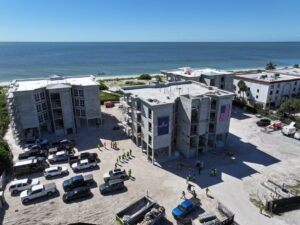
Historically, as sea levels naturally fluctuated over millennia, mangrove lines adapted by gradually migrating landward, colonizing newly inundated inland tidal flats. In modern Lee and Collier counties, however, that natural evolutionary escape route is completely blocked. High-density residential real estate developments, concrete seawalls, commercial shopping centers, and paved highway grids act as unyielding barriers along the shoreline. As the rising Gulf waters push the tide lines further inland, the mangroves are trapped against rigid urban infrastructure, causing the remaining habitats to steadily shrink.
Hardening Living Shorelines to Protect Local Value
The findings from this global modeling study reinforce the immediate need for regional real estate coordinators, master planners, and environmental groups to shift away from hard armoring strategies. Relying solely on concrete bulkheads can worsen coastal erosion by deflecting wave energy directly into adjacent, unprotected muddy beds.
To protect the remaining Southwest Florida mangrove carbon storage acreage, SCCF and local municipalities are aggressively advocating for the expansion of native living shorelines and public land acquisition buffers. By setting up wide, undeveloped green corridors landward of existing estuaries, communities can provide the spatial pathways necessary for mangrove forests to successfully migrate over the next century.
Securing these natural buffers does more than just trap carbon; it preserves a highly critical, multi-million dollar public safety shield. The dense, tangled root systems act as a powerful energy brake, absorbing massive storm surge heights and dampening high-velocity wave impacts before they can breach inland single-family neighborhoods.
Coastal Ecosystem Structural Summary
Conservation Insight: Preserving existing, mature mangrove sediment blocks delivers an immediate carbon mitigation benefit that cannot be replicated by simple tree-planting campaigns, as deep soil carbon storage takes decades to centuries to fully mature.
-
Global Footprint: Mangroves cover less than 1% of the Earth’s total surface area.
-
Carbon Disproportion: These coastal forests hold roughly 15% of all carbon stored in the world’s oceans.
-
Primary Vulnerability: Threshold failures occur when the sea-level rise rate permanently outpaces local soil accretion.
-
Migration Barriers: Rigid seawalls, roads, and residential real estate prevent natural landward relocation.
For real-time updates on regional shoreline planting initiatives, to evaluate local soil carbon tracking charts, or to participate in native propagation workshops, property owners can monitor findings hosted on the central registry at the Sanibel-Captiva Conservation Foundation Environmental Portal.