Collier County has officially secured $100,000 in dedicated grant funding to build a new Collier County artificial reef, advancing local efforts to restore offshore marine ecosystems while boosting sports fishing and diving tourism. The marine initiative directly tackles the degradation of natural undersea habitats caused by red tide events, coastal development, environmental runoff, and overfishing in the coastal waters of the Gulf.
Formally approved in August 2026 by County Manager Amy Patterson following the cancellation of the August 11 Board of County Commissioners meeting, the funding package will be ratified during the board’s August 25 meeting. The initiative pairs a $50,000 philanthropic contribution from the Collier Community Foundation with an equal $50,000 matching grant provided by the nonprofit Coastal Conservation Association Florida (CCA Florida).
Environmental and Ecological Benefits of the New Collier County Artificial Reef
The deployment of the new Collier County artificial reef is engineered to deliver immediate and lasting ecological benefits to Southwest Florida’s marine biosphere. According to marine biologists with CCA Florida, man-made structures create complex multi-tiered underwater topography that serves as essential nursery and feeding grounds for marine life.
Key biological and coastal advantages of the project include:
-
Sportfish & Predator Refuge: Establishing vital shelter and feeding zones for popular sportfish, including gag grouper, red snapper, mangrove snapper, and greater amberjack.
-
Benthic Invertebrate Colonization: Providing stable, hard surfaces for corals, sea sponges, algae, and mollusks to attach and flourish.
-
Erosion and Surge Dissipation: Off-shore submerged structures help dissipate incoming wave energy, offering a natural secondary buffer that helps protect delicate shorelines against erosion and tropical storm surges.
-
Rapid Ecosystem Formation: Marine studies indicate that baitfish and pelagic species begin congregating around newly submerged concrete modules within days of deployment.
Engineering, Deployment Logistics, and Site Location
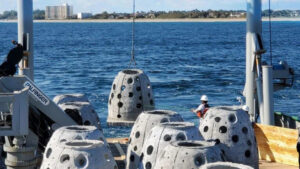
According to project filings prepared by County Coastal Management Program Manager Andrew Miller, the new Collier County artificial reef will utilize prefabricated concrete reef modules engineered to comply strictly with environmental specifications set by the Florida Fish and Wildlife Conservation Commission (FWC) and the U.S. Army Corps of Engineers.
The logistical plan for deployment involves several distinct operational phases:
-
Material Procurement & Transport: Up to 500 tons of environmentally safe structural materials such as clean concrete culvert pipes, bridge demolition pieces, light poles, and dense limestone boulders will be transported via dump trucks to regional staging docks. The total payload equals the carrying capacity of roughly 20 tractor-trailers.
-
Barge Loading & Transit: Heavy marine cranes will secure the modules onto specialized transport barges before navigating to the designated permitted reef site located approximately 10 miles off the coastline of Naples.
-
Submerged Placement: Specialized dive and marine crews will place the structures on the sea floor at precise GPS coordinates to maximize vertical relief and water circulation.
-
Three-Year Scientific Monitoring: Collier County staff and marine researchers will execute a comprehensive 36-month monitoring plan, tracking water quality, species diversity, and coral growth over time.
Continuing a Four-Decade Marine Conservation Legacy
This latest reef installation builds upon Collier County’s storied Paradise Coast Reef Program, first established in the early 1980s in collaboration with the cities of Naples and Marco Island. Over the last four decades, the county has constructed at least 37 artificial reef sites utilizing more than 18,000 tons of recycled concrete, transforming bare sand bottomland into flourishing aquatic havens.
By continuing to expand offshore reef systems, Collier County strengthens its position as a world-class ecotourism hub. Expanding underwater destinations takes recreational fishing and diving pressure off natural coral tracts while generating millions of dollars in annual economic activity for charter boat captains, tackle shops, marina operators, and hospitality providers across the Paradise Coast.
Project Overview & Funding Summary
| Project Dimension | Details & Specifications |
| Project Identity | New Collier County Artificial Reef (Paradise Coast Reef Program) |
| Total Project Funding | $100,000 ($50,000 Collier Community Foundation + $50,000 CCA Florida) |
| Project Location | Approximately 10 miles offshore from Naples in the Gulf |
| Material Weight | Up to 500 tons of clean concrete modules, culverts, and limestone boulders |
| Target Species | Grouper, snapper, amberjack, juvenile sportfish, sponges, and corals |
| Completion & Monitoring | Target deployment late 2026; 3-year ongoing biological monitoring study |