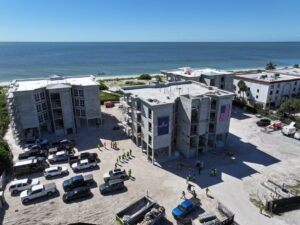
Florida voters are gearing up to make a crucial decision at the ballot box this November regarding the state’s property tax structure. While Amendment 3 is primarily advertised as a financial relief mechanism for primary homeowners by expanding the homestead exemption, a newly released economic study is raising red flags for the state’s massive population of tenants. According to comprehensive September research conducted by independent tax policy consultant Jared Walczak, there is a strong likelihood that the proposed legislation could unintentionally shift a massive tax burden onto apartment buildings. As a result, the Florida Amendment 3 rental costs could surge across Southwest Florida, threatening to exacerbate the ongoing housing affordability crisis along the Gulf coast.
Understanding the Potential Florida Amendment 3 Rental Costs Increase
To understand why a tax cut for homeowners could lead to a Florida Amendment 3 rental costs increase for tenants, it is essential to examine how municipal taxation and local budgets operate. Currently, Amendment 3 proposes to increase the homestead exemption for non-school property taxes to $250,000 by 2028. While this provides undeniable, direct tax relief for residents who own and occupy their primary homes, it simultaneously shrinks the overall taxable property base that local governments rely on to fund essential community services.
Because municipalities, county commissions, and special taxing districts are constitutionally required to balance their budgets annually, a massive reduction in homestead tax revenue leaves local leaders with limited options. They must either enact severe budget cuts to public safety, infrastructure, and parks, or they must raise the overarching tax rate (the millage rate) to compensate for the shortfall.
If local governments choose to raise the millage rate to bridge the revenue gap, that higher tax rate will automatically be applied to all non-homestead properties. This non-exempt category includes commercial real estate, industrial warehouses, vacation rentals, and, critically, multi-family apartment complexes. When the property tax bill on an apartment complex goes up, commercial landlords and corporate property managers rarely absorb the financial hit; instead, standard commercial real estate practices dictate that these increased operational expenses are passed directly down to the consumer in the form of higher monthly rent payments.
County-by-County Breakdown of Southwest Florida Impacts
The September study provides a detailed, localized projection of exactly how much the Florida Amendment 3 rental costs could increase by the time the amendment is fully implemented in 2028. Because property values and municipal budgets vary wildly from one jurisdiction to the next, the anticipated financial blow to renters will be highly localized based on geographic boundaries.
Across the entire state of Florida, Walczak’s analysis estimates that the average annual property tax increase on a standard apartment unit would hit $406. However, looking closely at the Southwest Florida market, the regional projections reveal a diverse economic impact:
-
Lee County: Renters in Fort Myers, Cape Coral, and Bonita Springs could see an estimated property tax pass-through increase of $340 per apartment unit annually.
-
Charlotte County: Tenants in Punta Gorda and Port Charlotte face a projected annual increase of $303 per apartment unit.
-
Collier County: Renters in the Naples and Marco Island markets would see a comparatively smaller, but still notable, impact of $134 per apartment unit annually.
These projected increases arrive at a particularly sensitive time for Southwest Florida’s workforce. As the region experiences a surge in luxury real estate demand highlighted in recent data showing that Naples area home sales continue to rise while inventory plummets essential workers in the hospitality, healthcare, and service sectors are already struggling to secure affordable housing near their places of employment.
How Local Government Decisions Will Shape the Florida Amendment 3 Rental Costs
It is important for voters to recognize that these projected Florida Amendment 3 rental costs are not explicitly written into the ballot language itself. Rather, they represent a highly probable economic chain reaction. The actual financial impact on local renters will ultimately depend on the difficult decisions made by city councils and county commissioners in the years following the election.
If local leaders decide to absorb the revenue losses by reducing municipal services, freezing civic hiring, or halting major public works projects such as the recently debated Cape Coral North 3 utility expansion pause then the millage rate may remain stable, shielding renters from sudden price hikes. However, if voters demand that current levels of emergency services, public works, and community programming remain fully funded, raising the tax rate on non-exempt apartment buildings will become the most viable path forward for local budget directors to keep their cities financially solvent.
As the election approaches, this complex dynamic has forced voters to weigh the immediate benefits of homestead tax relief against the broader economic ripple effects on the local rental market. To explore how the electorate is currently leaning on this critical issue, review our recent coverage of the statewide Florida Amendment 3 property tax poll.