The RSW terminal expansion AI construction project at Southwest Florida International Airport is setting a groundbreaking precedent for how large-scale municipal infrastructure is designed, managed, and executed. As the most expensive public works project in Lee County history, Phase Two of the airport’s expansion carries a colossal $1.2 billion price tag. To deliver this massive 14-gate terminal expansion on time and within budget, lead contractor Suffolk Construction has transformed a standard site trailer into a high-tech artificial intelligence nerve center near the Gulf coast corridor.
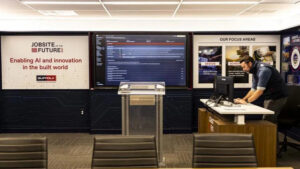
Breaking ground in October 2024, the structural framework topped out in December 2025 and remains firmly on target for full completion by October 2027. Across a service road from active tarmac operations, Suffolk’s “Trailer No. 3” houses dual big-screen video monitors and dedicated AI engineering hardware, serving as a primary launchpad for the firm’s national Jobsite of the Future (JOF) initiative.
Inside Suffolk’s “Jobsite of the Future” at RSW
Out of Suffolk Construction’s 275 active construction sites across the United States, RSW is one of only eight elite sites nationwide designated as an official Jobsite of the Future. Managing a daily workforce of roughly 500 construction tradespeople, 50 Suffolk staff members, and 15 to 20 subcontracting firms generates massive streams of project data.
To make sense of gigabytes of information including blueprints, email logs, material submittals, and historical data from every Suffolk project over the past 10 years the firm brought on site AI engineer Cary Greenwood, a former software engineer and data architect with experience at Raytheon, NASA, and the U.S. Army Corps of Engineers. Working alongside Assistant Project Manager Dwight Moe, Greenwood converts raw paper-heavy workflows into predictive insights.
The deployment of RSW terminal expansion AI construction systems focuses on three main areas:
-
Design Optimization: Pre-analyzing architectural plans to identify structural conflicts early, significantly reducing requests for information (RFIs) and avoiding costly field rework.
-
Predictive Scheduling: Mining historical project timelines to run dynamic simulations, allowing superintendents to spot potential bottlenecks months before crews arrive.
-
Process Efficiency: Streamlining daily administrative tasks, email correspondence, and subcontractor coordination to keep field teams focused on active building.
Slashing RFI Timelines from Hours to Minutes
In commercial building, an RFI (Request for Information) occurs whenever site superintendents or tradespeople uncover ambiguities in architectural blueprints. Historically, gathering data, cross-referencing specs, and drafting a formal RFI consumed six to eight hours of project manager time.
With customized generative AI tools connected to integrated project data silos, Greenwood and Moe reduced RFI drafting times to just 10 to 15 minutes. This 95% reduction in administrative friction allows project leaders to redirect hundreds of saved hours directly toward quality control and safety management.
Safety protocols have also received a major upgrade through custom predictive tools. By feeding active schedule data into safety models, project leaders can identify hazardous high-risk construction phases such as steel erection or high-elevation glazing in advance, putting defensive measures in place before crews step onto the rig.
Furthermore, field superintendents utilize voice-activated AI software during daily site walks. By speaking updates directly into handheld devices while inspecting concourse work, the software automatically translates verbal notes into P6 scheduling updates. This transfers real-time field knowledge directly into project management software, maintaining total timeline clarity across all 14 gate construction zones.
Transforming Infrastructure Across Southwest Florida
While Phase Two adds 14 new gates and concourse space under Suffolk’s AI leadership, Phase One of the terminal expansion—which reconfigures the main terminal building and expands post-security concessions is simultaneously underway under lead contractor Manhattan Construction.
The data gathered during the RSW terminal expansion AI construction rollout isn’t just benefiting the airport; it is actively training Suffolk’s regional AI models across several prominent Southwest Florida developments:
-
Legacy Point (formerly Southward Village) in Fort Myers.
-
Tampa General Hospital Urgent Care Center in Babcock Ranch.
-
Alva High School and Estero Sports Park educational and civic builds.
-
Collier County Veterans’ Nursing Home in the Naples area.
-
Luxury Residential Towers: Including Moorings Park Grande Lake, Ritz-Carlton Residences, and Avra at Metropolitan.
This massive airport modernization complements broader aviation and transit upgrades across the region. To see how neighboring hubs are expanding to meet traveler demand, review our coverage of the Punta Gorda Airport terminal expansion milestone or examine overall relocation trends in our detailed report on Florida net inbound moving searches. Furthermore, to see how municipal investments impact Lee County’s fiscal health, check out our analysis of the Fort Myers fiscal year financial performance report.
RSW Phase Two Terminal Expansion Snapshot
Operational Note: Implementing custom AI platforms does not replace human jobs on-site; rather, it empowers site managers and superintendents to work with greater speed, safety, and operational precision.
| Project Metric | Details & Specifications |
| Primary Facility | RSW terminal expansion AI construction (Phase Two) |
| Total Capital Investment | $1.2 Billion (Most expensive project in Lee County history) |
| Project Scope | New 14-gate terminal and expanded concourse facilities |
| Construction Timeline | Groundbroken Oct. 2024 |
| Daily Site Workforce | ~500 tradespeople, 50 Suffolk employees, 15-20 subcontractors |
| Lead Contractor | Suffolk Construction (Jobsite of the Future program) |
For official flight information, parking availability, or master expansion updates, passengers can review details directly on the Official Southwest Florida International Airport Portal.