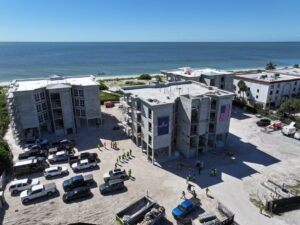
The Southwest Florida housing market FGCU report published on August 3 by Florida Gulf Coast University’s Regional Economic Research Institute (RERI) details an ongoing recalibration across the coastal real estate ecosystem. Following the historic post-pandemic surge that peaked in 2022, regional housing activity is stabilizing into a more balanced, disciplined environment.
According to RERI economists, the cooling trajectory is expected to persist in the near term. Rather than signaling market weakness, researchers attribute this shift to a dual contraction in new residential listings and fresh construction starts, allowing the region to absorb standing inventory while navigating broader macroeconomic pressures near the Gulf coast.
Supply Tightens as Listings and Permit Volumes Pull Back
A primary indicator highlighted in the Southwest Florida housing market FGCU report is a marked decline in housing supply metrics. Residential active listings dropped 14.4% in the second quarter of 2026 and logged a 20% year-over-year decline in June, marking the fifth consecutive month of inventory contractions across Lee, Collier, and Charlotte counties.
Simultaneously, homebuilders have scaled back ground-up development in response to elevated labor costs, insurance shifts, and borrowing rates. Single-family building permits dropped 20.3% through the first six months of 2026 compared to the same period in 2025, totaling 6,877 approved permits.
The inventory and permit trends present a clear, scannable look at the region’s supply metrics:
-
Residential Active Listings (June 2026): Down 20% year-over-year (5th straight monthly decline).
-
Residential Active Listings (Q2 2026): Contracted 14.4% across coastal counties.
-
Single-Family Building Permits (H1 2026): Totaled 6,877 permits, down 20.3% compared to H1 2025.
-
Market Impact: Reduced new construction prevents inventory oversupply, supporting long-term valuation floors.
Strong Buyer Demand Creates Regional Price Disparities
Despite lower listing volumes, buyer demand across Southwest Florida remains active for correctly priced properties. Single-family home sales reached 2,678 transactions in April, recording the highest monthly sales volume since the 2022 market peak.
However, median single-family home prices reflect significant geographic variation across the three main coastal counties:
| County Sub-Market | Regional Price Snapshot | Market Dynamics & Growth |
| Charlotte County (Punta Gorda MSA) | $360,000 Median Price | Entry-level market undergoing inventory adjustments. |
| Lee County (Cape Coral-Fort Myers MSA) | Mid-Tier Value Core | Balanced sales activity supported by strong inbound migration. |
| Collier County (Naples MSA) | $850,000 Median Price | High-end demand insulated by cash-driven luxury buyers. |
Connecting Real Estate Metrics to Regional Economic Trends
The housing rebalancing documented by FGCU aligns with broader economic adjustments occurring throughout the region. While local employment and consumer spending show selective softening, tourism and transit infrastructure continue to demonstrate resilience.
To see how these housing trends interact with other regional sectors, explore our analysis of the Punta Gorda foreclosure rates midyear report or review the latest employment metrics in our coverage of the Florida unemployment rate June 2026 report. Furthermore, to track how buyer demand intersects with local community costs, read our detailed report on how Naples HOA fees influence homebuying decisions.
FGCU Housing Report Fast Facts
Analyst Note: FGCU researchers view the simultaneous drop in building permits and active listings as a stabilizing mechanism that prevents rapid price depreciation across Southwest Florida.
-
Reporting Agency: Regional Economic Research Institute (RERI) at Florida Gulf Coast University.
-
Peak Single-Family Sales: 2,678 closed sales recorded in April (highest since 2022).
-
Regional Price Spread: Ranging from $360,000 in Charlotte County to $850,000 in Collier County.
-
Primary Supply Driver: 20.3% drop in single-family permits slowing new home construction.
For complete economic indicator dashboards, business survey data, or regional research reports, visit the Official FGCU Regional Economic Research Institute Portal.